In 2020, QR codes were the thing your dentist used for check-in. By 2025, they processed over $3 trillion in payments globally and became the default bridge between physical and digital. The 12 months ahead will see QR codes move from utility to infrastructure — embedded in cars, woven into identity systems, and personalized through AI. This guide breaks down the 5 trends that will define QR codes in 2026, with the data behind each and what your business should do to take advantage.
By the end, you’ll know what QR codes are doing in 2026, why it matters, and exactly which trends to invest in for your business.
2025: The Year QR Codes Became Infrastructure
Before we look forward, let’s ground in where we are. 2025 was a watershed year for QR codes.
2025 by the numbers
Some standout statistics from the past 12 months:
- 5.3 billion QR codes created or scanned in 2025 (up 24% from 2024)
- $3.1 trillion in payment value processed via QR codes globally
- 89 million Americans scanned a QR code in 2025 (32% of the adult population)
- 2.7 billion smartphones with QR code scanning capability are in active use worldwide
- 78% of US restaurants now use QR codes for menus (up from 41% in 2022)
These numbers aren’t just growth — they represent a fundamental shift in how people interact with the world. QR codes are no longer a novelty; they’re a default.
What changed in 2025
Three things made 2025 different from previous years:
1. Native camera scanning went universal. Both iOS and Android now scan QR codes directly through the camera app, with no third-party software required. As of 2025, every smartphone made in the last 5 years can scan QR codes out of the box.
2. Payment integration went mainstream. Apple, Google, PayPal, Venmo, and most regional payment apps now support QR code payments natively. The friction of "open app, scan, pay" has been reduced to "scan, pay."
3. Design went from afterthought to feature. Branded QR codes with logos, custom shapes, and brand colors became the norm rather than the exception. Tools like QR Code Monkey, Canva, and Adobe Express made it easy for non-designers to create beautiful, on-brand codes.
Trend 1: AI-Personalized QR Codes
The first major trend for 2026: QR codes that adapt their behavior based on the user scanning them.
What is AI-personalized QR code?
Instead of pointing all users to the same destination, an AI-personalized QR code routes each scanner to a destination tailored to them. The code itself looks identical; the routing is dynamic.
How it works
When someone scans an AI-personalized QR code, the system captures metadata (without personally identifying the user):
- Device type and operating system
- Approximate location (city or region)
- Time of day
- Previous interactions with the same brand (if logged in)
- Browser language and settings
The AI then routes the user to the most appropriate destination based on this context. A QR code on a billboard in Tokyo at 8 AM might route Japanese commuters to a transit app, while the same code at 8 PM might route tourists to a restaurant guide.
Real-world examples already happening
Several companies are deploying AI-personalized QR codes in 2025-2026:
- McDonald’s tests QR codes on tray liners that route to the app for mobile users and to a web menu for desktop scanners
- Uber uses QR codes on billboards that detect the user’s location and open the app pre-set with that pickup point
- Disney uses QR codes on park maps that route to a personalized itinerary based on the user’s app history
What this means for businesses
In 2026, expect AI-personalized QR codes to be table stakes for any high-traffic marketing campaign. The infrastructure is available today (from services like Bitly, Beaconstac, and Dynamic Code); the AI routing layer is the new piece. Budget for this if you’re running large campaigns.
Trend 2: Dynamic QR Codes Become the Default
Static QR codes (with the destination baked in) are giving way to dynamic codes (with the destination editable) as the default. In 2024, dynamic codes were about 35% of all QR codes created. In 2025, that number hit 60%. By end of 2026, expect 80%+.
Why dynamic codes are winning
Three reasons dynamic codes are becoming the default:
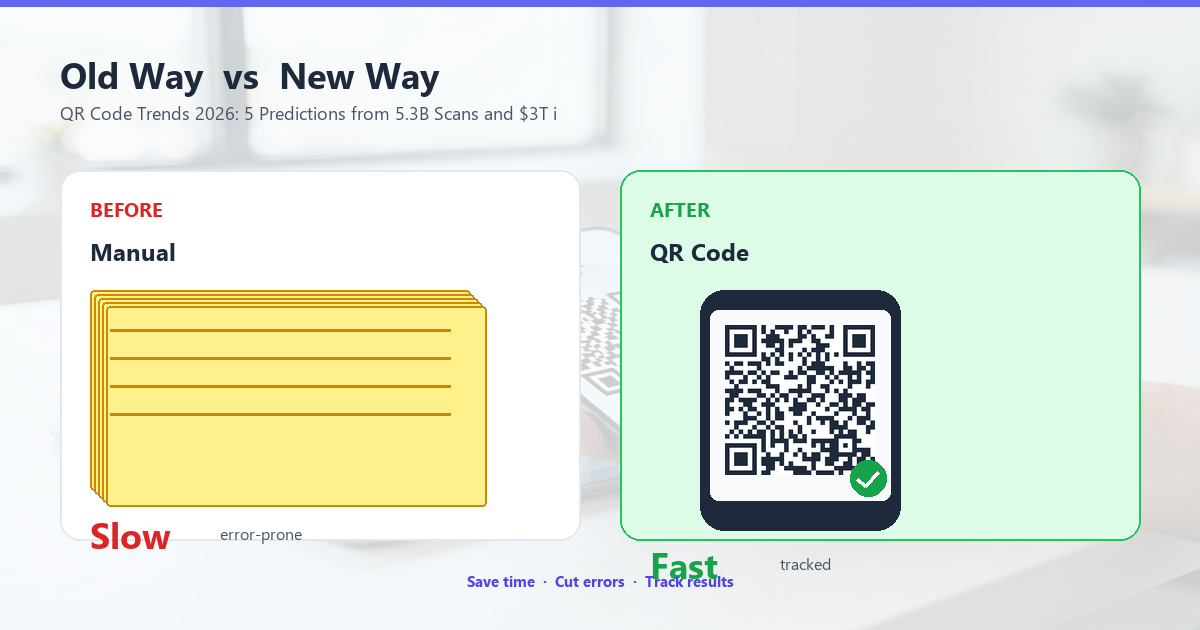
1. Editability is too valuable. Static codes require reprinting if the destination changes. Dynamic codes let you update the destination anytime. For a real estate agent, this is the difference between printing a new sign every time a price changes versus updating a URL.
2. Analytics are now expected. Marketers want to know how many people scanned, when, where, and on what device. Dynamic codes provide this data; static codes don’t.
3. Cost has come down. Dynamic code services used to charge $50-200/month. Now free tiers and $5-20/month plans make them accessible to any business.
What this means for businesses
If you’re still using static codes for marketing, switch to dynamic. The data alone is worth the small monthly cost. If you’re using static codes for permanent installations (building signage, equipment labels), those are still appropriate — they’re not going anywhere.
Trend 3: Multi-Purpose QR Codes
The third trend: QR codes that do more than just open a URL. They become interactive hubs.
What is a multi-purpose QR code?
Instead of "scan to open a URL," multi-purpose QR codes offer a menu of options after scanning:
- Open the menu, view photos, or book a table (restaurants)
- Add a contact, view a profile, or book a meeting (business cards)
- Read the manual, watch a setup video, or register the product (product packaging)
- Pay, get a receipt, or join a loyalty program (point of sale)
Why this matters
For users, it means one scan does everything they need. For businesses, it means one code serves multiple purposes, replacing what would otherwise be 3-5 separate codes or pieces of printed information.
Real-world examples
Multi-purpose QR codes are already in use:
- Starbucks: One code on the cup that links to the menu, the app, the rewards program, and the store locator
- IKEA: One code on furniture that links to assembly instructions, the product page, and the warranty registration
- Aeromexico: One code on the boarding pass that links to the gate, the lounge, the in-flight menu, and the car rental partners
What this means for businesses
In 2026, expect the multi-purpose QR code to become the standard. If you’re putting a single URL in your codes today, start thinking about what else your customers want from the same touchpoint. The toolset is available (from services like Moby, Kezava, and custom development); the design pattern is established.
Trend 4: Sustainability and the Paperless Push
The fourth trend: QR codes continue to replace paper, with measurable environmental impact.
QR codes and paper reduction
Every QR code that replaces a paper document, menu, brochure, or sign has measurable environmental impact. A typical restaurant that switches to QR code menus can save 30-50% of their paper costs. A company that replaces printed user manuals with QR code links to digital manuals can save millions of pages per year.
The corporate sustainability angle
In 2026, sustainability metrics matter for every business. QR codes offer an easy, measurable win:
- Restaurant menus: 30-50% paper reduction
- Event tickets: 80-90% paper reduction (digital tickets vs. printed)
- Product manuals: 70-90% paper reduction
- Receipts: 100% paper reduction (digital receipts via QR code)
- Marketing brochures: 50-80% paper reduction
What this means for businesses
If your business has sustainability goals, QR codes are one of the easiest levers to pull. Switching paper-based materials to QR-linked digital materials is a quick win with measurable impact. The data can be included in your annual sustainability report, and the cost savings are real.
The catch: digital still has carbon
Digital infrastructure has its own carbon footprint — servers, networks, devices. The lifecycle analysis of paper vs. digital is complex. But for most business use cases, QR codes that reduce paper consumption also reduce overall environmental impact.
Trend 5: Security and Authentication
The fifth trend: QR codes become a primary authentication and verification mechanism.
QR codes for identity verification
Already in 2025, QR codes are used for:
- Two-factor authentication (scan a code, confirm the login on a trusted device)
- Age verification (scan ID, confirm age without sharing full ID details)
- Health pass verification (COVID-era, but the infrastructure is now used for general health records)
- Driver’s license verification (some US states have digital driver’s licenses with QR codes)
QR codes for product authentication
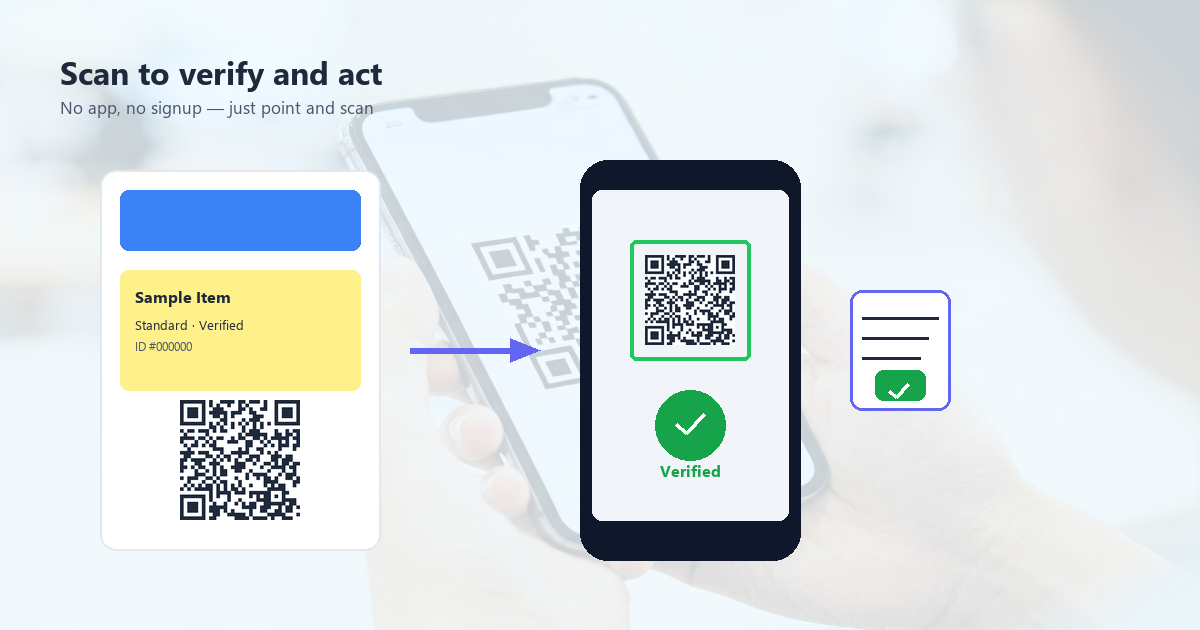
Luxury brands, electronics manufacturers, and pharmaceutical companies use QR codes to verify product authenticity. Scan a code, see the product’s provenance and authenticity certificate. This combats counterfeiting, which is a $500 billion annual problem.
QR codes for ticketing and event access
Every major event ticketing system now uses QR codes. The code encodes the ticket details and is scanned at the gate. The dynamic nature of these codes (rotating, expiring, location-validated) makes them more secure than static barcodes.
What this means for businesses
For most businesses, the security implication is straightforward: if you have valuable products, services, or information, consider adding QR-code-based verification. It’s a low-cost way to add a layer of trust and reduce fraud.
Bonus Trends to Watch
Beyond the top 5, several smaller trends are worth watching in 2026.
Animated QR codes
Animated QR codes (where the code briefly changes pattern in a loop) are an emerging format. They’re more eye-catching than static codes and have higher scan rates. The catch: not all scanners handle the animation correctly yet. Expect this to mature through 2026.
Frame QR codes
Frame QR codes (rectangular instead of square) can fit more data in less space and look more modern. They’re increasingly supported by modern phones. If you’re designing new QR codes, consider this format.
QR codes in AR
Some brands are now using QR codes to trigger augmented reality experiences. Scan a code on a product box, see a 3D animation of the product in your space. This is still early-adopter territory, but expect more examples in 2026.
QR codes in voice assistants
Some smart speakers and voice assistants can now recognize QR codes from camera input. This opens up voice-controlled QR interactions, though the use cases are still emerging.
QR codes in vehicles
Several car manufacturers are integrating QR code scanning into their infotainment systems. Scan a code on a parking meter, a restaurant menu, or a billboard, and the content opens on the car’s display. This is a 2026-2027 trend to watch.
Industry-by-Industry Outlook
Different industries will adopt these trends at different speeds. Here’s what to expect in 2026.
Retail and restaurants
Already at high adoption. Expect multi-purpose QR codes (combining menu, payment, loyalty, and feedback) to become the norm. AI-personalization for frequent customers will start.
Events and entertainment
QR code tickets are already standard. Expect dynamic, location-validated codes to enhance security. AR-triggered QR codes for venue experiences will start appearing.
Healthcare
QR codes for patient check-in, prescription refills, and health record access are growing. Expect broader adoption in 2026, especially for telemedicine and remote patient monitoring.
Education
QR codes for student check-in, accessing course materials, and submitting assignments are growing. Expect more interactive QR experiences in 2026.
Manufacturing and logistics
QR codes for inventory tracking, product authentication, and supply chain transparency are well-established. Expect more AI-integrated use cases in 2026.
Real estate
QR codes on listings, yard signs, and open house materials are growing. Expect more dynamic codes with virtual tour integration in 2026.
Travel and hospitality
QR codes for check-in, room keys, and local information are increasingly standard. Expect more contactless integration with NFC for premium experiences.
What Your Business Should Do in 2026
Translating these trends into action for your business. Here’s a practical 6-month roadmap.
Month 1: Audit your current QR code usage
List every place your business currently uses QR codes. For each, note: is it static or dynamic? Does it have analytics? What’s the destination? What could it be doing better?
Month 2: Convert static to dynamic
For any high-traffic QR code (touchpoint with 100+ scans per month), switch to dynamic. The data alone is worth it.
Month 3: Add analytics tracking
Make sure every dynamic QR code is tracked. Set up a dashboard (Google Analytics, or your QR code service’s native analytics) to see scans by location, time, and device.
Month 4: Design for your brand
Replace any plain black-and-white QR codes with branded codes that include your logo, brand colors, and custom module shapes. Test for scan reliability before mass deployment.
Month 5: Plan multi-purpose codes
Identify 2-3 touchpoints where a multi-purpose QR code (offering a menu of options after scanning) would benefit your customers. Plan the implementation.
Month 6: Launch and iterate
Deploy the multi-purpose codes. Track performance. Iterate based on data. In 2026, the businesses that win with QR codes are the ones that treat them as a measured, iterated channel, not a one-off marketing gimmick.
Metrics to Watch in 2026
To stay ahead of these trends, track these metrics for your QR code campaigns.
Scan rate
What percentage of people who see your QR code actually scan it? Industry benchmark: 5-15% for general marketing, 30-50% for contextual placements (like on the table in a restaurant).
Conversion rate
Of those who scan, what percentage complete the desired action (purchase, signup, etc.)? Industry benchmark: 2-10% depending on the action and the destination.
Scan-to-action time
How long does it take from scan to action completion? Track this to optimize the destination experience. Goal: under 30 seconds for most actions.
Device breakdown
What devices are scanning? iPhone vs. Android, mobile vs. tablet. Optimize the destination for the most common devices.
Location breakdown
Where are scans coming from? For yard signs, this is geographic. For event materials, it’s table-by-table or session-by-session.
Time of day
When do scans happen? Use this to optimize when your marketing materials are most active (e.g., schedule social posts for peak scan times).
Tools to Watch in 2026
The QR code tool landscape is consolidating. Here are the tools worth evaluating.
For design and branding
Canva (most accessible, free tier available), QR Code Monkey (best free static codes), Adobe Express (best for Adobe ecosystem users).
For dynamic codes and analytics
Beaconstac (best analytics, premium pricing), Bitly QR Codes (good integration with Bitly’s link shortener), QR Tiger (good balance of features and price), Flowcode (best for consumer brands), The QR Code Generator (good for small businesses).
For enterprise and developers
Scanova, QRAPI, Uniqode (formerly known as "QR Code Generator Pro"). These have APIs for integrating QR code generation and tracking into custom applications.
For specific use cases
Restaurants: Menutech, Chownow, Square. Real estate: KvCORE, Spacio, Open Home Pro. Events: Eventbrite, Bizzabo, Cvent.
Regional Outlook
QR code adoption varies significantly by region. Here’s what to expect in 2026.
North America
Mature market. QR codes are standard in restaurants, retail, and ticketing. 2026 will see growth in payments, multi-purpose codes, and AI-personalization.
Europe
High adoption, especially in retail and ticketing. Privacy regulations (GDPR) may slow some AI-personalization use cases. Expect growth in authentication and verification use cases.
Asia-Pacific
Most mature market. China and Southeast Asia have been QR-first for years. 2026 will see continued growth in payments, identity, and integration with super-apps.
Latin America
Growing market. Brazil, Mexico, and Argentina are leading adoption. Expect significant growth in 2026, especially in retail and payments.
Middle East and Africa
Emerging market. UAE, Saudi Arabia, and South Africa are leading adoption. 2026 will see growth in payments and government services.
Risks and Challenges
Not everything is rosy. Here are the risks to watch in 2026.
Phishing and fraud
As QR codes become more universal, they become a more attractive target for scammers. Phishing QR codes in parking lots, fake codes on restaurant menus, and email-based QR scams are all growing. User education and platform-level safeguards will be increasingly important.
Privacy concerns
AI-personalized QR codes require data collection. Users are increasingly aware of and resistant to data collection. Businesses that over-collect or misuse data will face backlash. Transparency and user control are essential.
Technology fragmentation
Different platforms (iOS, Android, WeChat, custom apps) handle QR codes differently. Some support advanced features, others don’t. For maximum reach, stick with the standard QR code format.
Dependency on third-party services
If you use a third-party service for dynamic QR codes and analytics, you’re dependent on that service continuing. If they shut down, your codes break. Consider self-hosting or backup options for critical use cases.
Frequently Asked Questions
Are QR codes still relevant in 2026?
More than ever. QR codes are the universal bridge between physical and digital, and the trends (AI personalization, multi-purpose codes, authentication) are making them more valuable, not less.
Will Apple’s Visual Look Up or similar tech replace QR codes?
No. These computer vision tools can recognize QR codes in photos, but they don’t replace the standard camera-based scanning. QR codes are simpler, more reliable, and more universally supported.
Should I switch from static to dynamic QR codes?
For high-traffic marketing, yes. For permanent installations (building signage, equipment labels), static is still appropriate. The data alone from dynamic codes justifies the small cost for any high-traffic use case.
What about the security risks of QR codes?
Phishing QR codes are a real problem, but the risk is manageable. Train your users to verify the destination before interacting. Use branded QR codes (which are harder to fake) for sensitive use cases. The industry is developing platform-level safeguards that will help.
Are QR codes still used after the COVID-19 pandemic?
Yes, dramatically. The pandemic introduced QR codes to many users who hadn’t used them before. Post-pandemic, those users continued to use them for menus, payments, ticketing, and more. QR code usage has continued to grow every year since 2020.
How do I start using AI-personalized QR codes?
Start with a dynamic QR code service that supports routing rules (Bitly, Beaconstac, Uniqode). Set up simple rules first: route iOS users to the App Store, Android users to Google Play. Gradually add more sophisticated AI-driven routing.
What’s the best QR code generator for 2026?
Depends on your needs. For most businesses, a free static generator (QR Code Monkey) plus a paid dynamic service (Beaconstac or QR Tiger) covers 95% of use cases.
What to Read Next
If you want to go deeper on the trends and how to take advantage of them, these guides are for you:
- QR Code Statistics 2025 — The full 2025 data, including the 5.3 billion scans and $3.1 trillion in payments
- Dynamic vs Static QR Codes — Why dynamic is winning, and how to switch
- QR Code History — How QR codes went from a Japanese car-parts invention to a $3 trillion infrastructure
- QR Code Design Best Practices — Branded, high-contrast QR codes that scan reliably
- QR Code for Payments — The use case where the trends are moving fastest
2026 is the year QR codes become invisible infrastructure — embedded in everything, recognized by everyone, and powering a layer of the physical world that connects to digital in ways we’re only beginning to explore. The businesses that win in this transition are the ones that treat QR codes as a strategic channel, not a tactical afterthought. Start now, measure everything, and iterate based on data.